
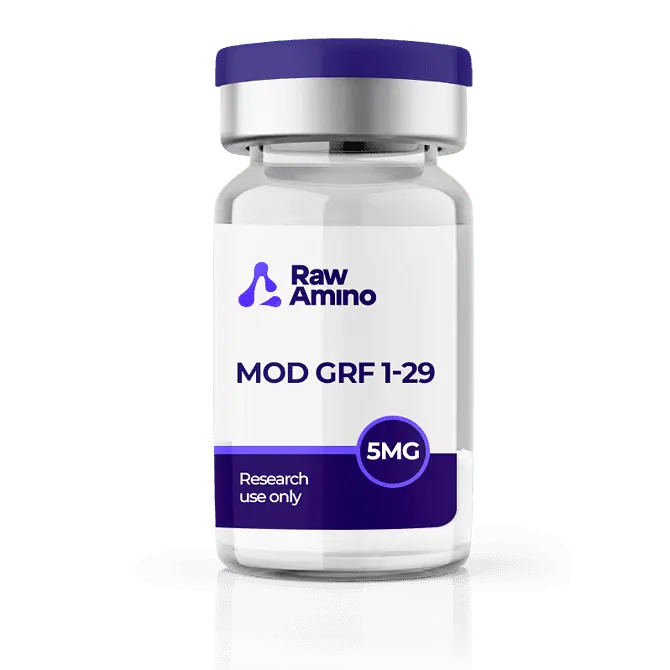
Scientific Overview of Mod GRF (1-29)
Modified GRF (1-29), also known as Mod GRF (1-29) or CJC-1295 without DAC, is a synthetic analog derived from the naturally occurring growth hormone-releasing hormone (GHRH). Researchers in the 1980s observed that the first 29 amino acids of GHRH appeared to retain many of the same properties as the full-length 44-residue protein. This truncated sequence, known as GRF (1-29), became the foundation for further structural modifications designed to improve stability and receptor interactions.
The modified version incorporates four amino substitutions, a change that may increase receptor affinity while providing enhanced protection against oxidation and enzymatic degradation during synthesis and storage. Modified GRF (1-29) is sometimes referred to as Tetra-substituted GRF (1-29) to emphasize these alterations. Importantly, it is structurally similar to the research compound CJC-1295 without the DAC modification.
Alternative Names: Modified GRF (1-29), CJC-1295 (No DAC), Modified GRF, Tetra-substituted GRF (1-29)
Mod GRF (1-29) Studies and Research Data
Mod GRF (1-29) Investigations in Cardiac Models
Studies involving rodents and larger animals such as swine have suggested that growth hormone–releasing hormone analogs, including modified GRF (1-29), may contribute to cardiac tissue remodeling. In some research, observations included potential improvements in pumping capacity, reductions in infarct size, and attenuation of hypertrophy. These findings suggest that GHRH derivatives may play a role in pathways linked with myocardial preservation and repair following injury.
Interactions with Thyroid-Related Pathways
Thyroid hormone status appears to influence the responsiveness of somatotroph cells to GRF (1-29). Research in individuals with hypothyroidism and experimental studies involving hormone replacement propose that thyroxine administration may enhance the response to GRF stimulation. These findings raise the possibility that thyroid regulation may intersect with growth hormone pathways, potentially impacting endocrine interactions in complex ways.
Gastrointestinal and Receptor Studies
Investigations in non-human primates suggested that modified GRF (1-29) may bind to vasoactive intestinal peptide (VIP) receptors, potentially influencing smooth muscle activity within gastrointestinal, reproductive, and urinary systems. Some studies proposed a connection between GRF analogs and bowel motility, which could be relevant for understanding mechanisms underlying intestinal regulation. Experimental work in rat pancreas also indicated receptor-level interactions that may provide insight into cross-reactivity among peptide families.
Conclusion
Modified GRF (1-29) has been studied in diverse biological contexts, including cardiovascular remodeling, thyroid-associated regulation of hormone release, and gastrointestinal receptor interactions. Findings suggest potential roles in cardiac tissue preservation, endocrine signaling modulation, and smooth muscle activity. While these studies highlight intriguing directions for continued exploration, research remains preliminary and further investigation is needed to fully clarify the significance of this modified GHRH analog.
References
- Jetté, L., Léger, R., Thibaudeau, K., Benquet, C., Robitaille, M., Pellerin, I., Paradis, V., van Wyk, P., Pham, K., & Bridon, D. P. (2005). Human growth hormone-releasing factor (hGRF)1-29-albumin bioconjugates activate the GRF receptor on the anterior pituitary in rats: identification of CJC-1295 as a long-lasting GRF analog. Endocrinology, 146(7), 3052–3058. https://doi.org/10.1210/en.2004-1286
- Waelbroeck, M., Robberecht, P., Coy, D. H., Camus, J. C., De Neef, P., & Christophe, J. (1985). Interaction of growth hormone-releasing factor (GRF) and 14 GRF analogs with vasoactive intestinal peptide (VIP) receptors of rat pancreas. Endocrinology, 116(6), 2643–2649. https://doi.org/10.1210/endo-116-6-2643
- Valcavi, R., Jordan, V., Dieguez, C., John, R., Manicardi, E., Portioli, I., Rodriguez-Arnao, M. D., Gomez-Pan, A., Hall, R., & Scanlon, M. F. (1986). Growth hormone responses to GRF 1-29 in patients with primary hypothyroidism before and during replacement therapy with thyroxine. Clinical endocrinology, 24(6), 693–698. https://doi.org/10.1111/j.1365-2265.1986.tb01666.x
- Ito, T., Igarashi, H., Pradhan, T. K., Hou, W., Mantey, S. A., Taylor, J. E., Murphy, W. A., Coy, D. H., & Jensen, R. T. (2001). GI side-effects of a possible therapeutic GRF analogue in monkeys are likely due to VIP receptor agonist activity. Peptides, 22(7), 1139–1151. https://doi.org/10.1016/s0196-9781(01)00436-3
- Schally, A. V., Zhang, X., Cai, R., Hare, J. M., Granata, R., & Bartoli, M. (2019). Actions and Potential Therapeutic Applications of Growth Hormone-Releasing Hormone Agonists. Endocrinology, 160(7), 1600–1612. https://doi.org/10.1210/en.2019-00111
- Cen, L. P., Ng, T. K., Chu, W. K., & Pang, C. P. (2022). Growth hormone-releasing hormone receptor signaling in experimental ocular inflammation and neuroprotection. Neural regeneration research, 17(12), 2643–2648. https://doi.org/10.4103/1673-5374.336135
Disclaimer:
The products mentioned are intended solely for laboratory research and in-vitro experimentation. They are not approved for human or animal use of any kind. All details provided are for educational purposes only. By purchasing from this site, you agree to comply with our Terms and Conditions.
Reviews
There are no reviews yet.