
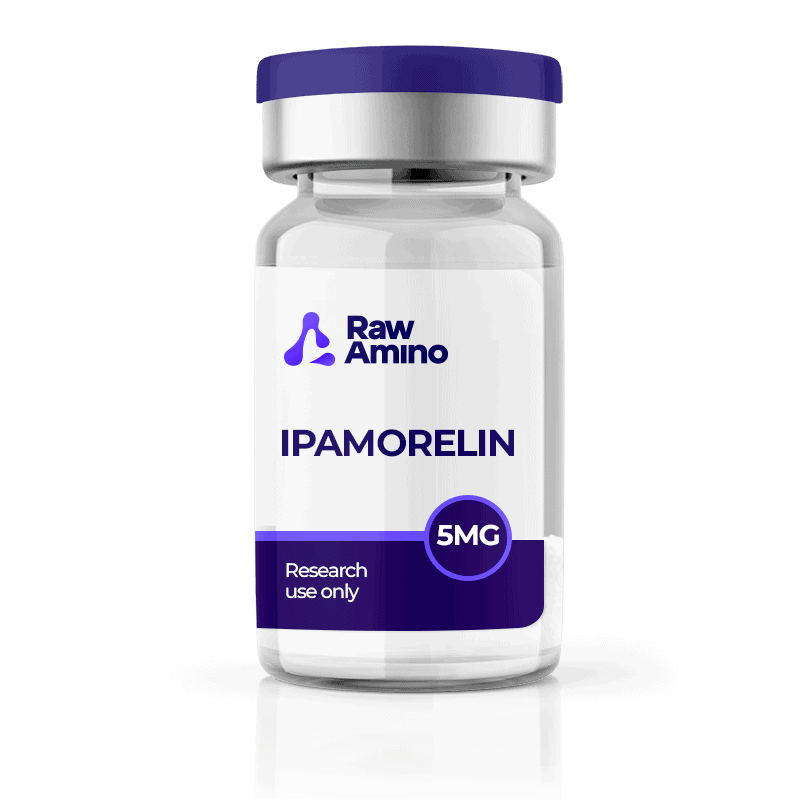
Scientific Overview of Ipamorelin
Ipamorelin is a synthetic pentapeptide often explored for its interaction with ghrelin and growth hormone secretagogue receptors. Research suggests that it may demonstrate selective receptor activity, which has made it a point of interest in laboratory investigations related to receptor binding and cellular signaling.
Alternative Names: Ipamorelin Peptide
Ipamorelin Studies and Research Data
Receptor Interaction and Cellular Signaling
Research indicates that Ipamorelin may act as a selective agonist of the ghrelin receptor, sometimes referred to as growth hormone secretagogue receptor type 1a (GHS-R1a). Investigations propose that its interaction with pituitary cells might initiate signaling cascades involving phospholipase C, which could influence intracellular calcium release and protein kinase pathways. This series of events may suggest a role in vesicular activity associated with hormone secretion.
Ipamorelin Investigations in Musculoskeletal Models
Laboratory studies with animal models have suggested that Ipamorelin may contribute to changes in bone density and formation. Certain findings point to the possibility that it could counteract glucocorticoid-associated bone reduction and potentially stimulate osteoblast activity. Dual-energy X-ray absorptiometry (DEXA) and computed tomography observations have been used in research to evaluate these outcomes, which appeared to suggest measurable changes in bone mineral content.
Exploration in Pancreatic and Glucose Research
Some murine experiments suggest that Ipamorelin may influence insulin secretion through indirect stimulation of calcium channels on pancreatic islet cells. This proposed pathway has prompted interest in its potential role in glucose regulation, although such research remains in preliminary stages.
Nitrogen Balance and Muscle Tissue Studies
Findings from rat research indicate that Ipamorelin may help adjust nitrogen balance following glucocorticoid exposure. Data suggests that this could involve modulation of urea cycle enzymes in the liver and changes in messenger RNA expression. These results tentatively point to a possible reduction in nitrogen loss under certain laboratory conditions.
Ipamorelin Applications as a Research Probe
Because of its selective binding to ghrelin receptors, Ipamorelin has been studied as a potential probe for imaging techniques such as positron emission tomography (PET). Researchers have proposed its use in exploring receptor distribution in laboratory models.
Investigations into Digestive Processes and Food Intake
Animal studies suggest that Ipamorelin may accelerate gastric emptying and potentially shorten recovery time from experimentally induced gastric slowdowns. Additional work proposes that it may alter food consumption patterns in animal models through interactions with ghrelin receptors in the nervous system. In certain cases, increases in body mass were observed, potentially linked to changes in adipose tissue deposition.
Conclusion
Ipamorelin is under investigation in a variety of research contexts, including receptor binding, musculoskeletal biology, pancreatic function, nitrogen regulation, imaging applications, and digestive processes. Current studies highlight its potential as a selective model compound, though outcomes remain exploratory and require further inquiry to clarify mechanisms and implications.
References
- Lall, S., Tung, L. Y., Ohlsson, C., Jansson, J. O., & Dickson, S. L. (2001). Growth hormone (GH)-independent stimulation of adiposity by GH secretagogues. Biochemical and biophysical research communications, 280(1), 132–138. https://doi.org/10.1006/bbrc.2000.4065
- Greenwood-Van Meerveld B, Tyler K, Mohammadi E, Pietra C. Efficacy of ipamorelin, a ghrelin mimetic, on gastric dysmotility in a rodent model of postoperative ileus. J Exp Pharmacol. 2012 Oct 19;4:149-55. doi: 10.2147/JEP.S35396. PMID: 27186127; PMCID: PMC4863553.
- Jiménez-Reina, L., Cañete, R., de la Torre, M. J., & Bernal, G. (2002). Influence of chronic treatment with the growth hormone secretagogue Ipamorelin, in young female rats: somatotroph response in vitro. Histology and histopathology, 17(3), 707–714. https://doi.org/10.14670/HH-17.707
- Raun K, Hansen BS, Johansen NL, Thøgersen H, Madsen K, Ankersen M, Andersen PH. Ipamorelin, the first selective growth hormone secretagogue. Eur J Endocrinol. 1998 Nov;139(5):552-61. doi: 10.1530/eje.0.1390552. PMID: 9849822.
- Childs MD, Luyt LG. A Decade’s Progress in the Development of Molecular Imaging Agents Targeting the Growth Hormone Secretagogue Receptor. Mol Imaging. 2020 Jan-Dec;19:1536012120952623. doi: 10.1177/1536012120952623. PMID: 33104445; PMCID: PMC8865914.
- Sinha DK, Balasubramanian A, Tatem AJ, Rivera-Mirabal J, Yu J, Kovac J, Pastuszak AW, Lipshultz LI. Beyond the androgen receptor: the role of growth hormone secretagogues in the modern management of body composition in hypogonadal males. Transl Androl Urol. 2020 Mar;9(Suppl 2):S149-S159. doi: 10.21037/tau.2019.11.30. PMID: 32257855; PMCID: PMC7108996 https://www.ncbi.nlm.nih.gov/pmc/articles/PMC7108996/
- Andersen NB, Malmlöf K, Johansen PB, Andreassen TT, Ørtoft G, Oxlund H. The growth hormone secretagogue ipamorelin counteracts glucocorticoid-induced decrease in bone formation of adult rats. Growth Horm IGF Res. 2001 Oct;11(5):266-72. doi: 10.1054/ghir.2001.0239. PMID: 11735244.
- Adeghate E, Ponery AS. Mechanism of ipamorelin-evoked insulin release from the pancreas of normal and diabetic rats. Neuro Endocrinol Lett. 2004 Dec;25(6):403-6. PMID: 15665799.
- Svensson, J., Lall, S., Dickson, S. L., Bengtsson, B. A., Rømer, J., Ahnfelt-Rønne, I., Ohlsson, C., & Jansson, J. O. (2000). The GH secretagogues ipamorelin and GH-releasing peptide-6 increase bone mineral content in adult female rats. The Journal of endocrinology, 165(3), 569–577. https://doi.org/10.1677/joe.0.1650569
- Gobburu, J.V.S., Agersø, H., Jusko, W.J. et al. Pharmacokinetic-Pharmacodynamic Modeling of Ipamorelin, a Growth Hormone Releasing Peptide, in Human Volunteers. Pharm Res 16, 1412–1416 (1999).
- Johansen PB, Nowak J, Skjaerbaek C, Flyvbjerg A, Andreassen TT, Wilken M, Orskov H. Ipamorelin, a new growth-hormone-releasing peptide, induces longitudinal bone growth in rats. Growth Horm IGF Res. 1999 Apr;9(2):106-13. doi: 10.1054/ghir.1999.9998. PMID: 10373343.
- Aagaard, N. K., Grøfte, T., Greisen, J., Malmlöf, K., Johansen, P. B., Grønbaek, H., Ørskov, H., Tygstrup, N., & Vilstrup, N. (2009). Growth hormone and growth hormone secretagogue effects on nitrogen balance and urea synthesis in steroid treated rats. Growth hormone & IGF research: official journal of the Growth Hormone Research Society and the International IGF Research Society, 19(5), 426–431. https://doi.org/10.1016/j.ghir.2009.01.001
Disclaimer:
The products mentioned are intended solely for laboratory research and in-vitro experimentation. They are not approved for human or animal use of any kind. All details provided are for educational purposes only. By purchasing from this site, you agree to comply with our Terms and Conditions.
Reviews
There are no reviews yet.