
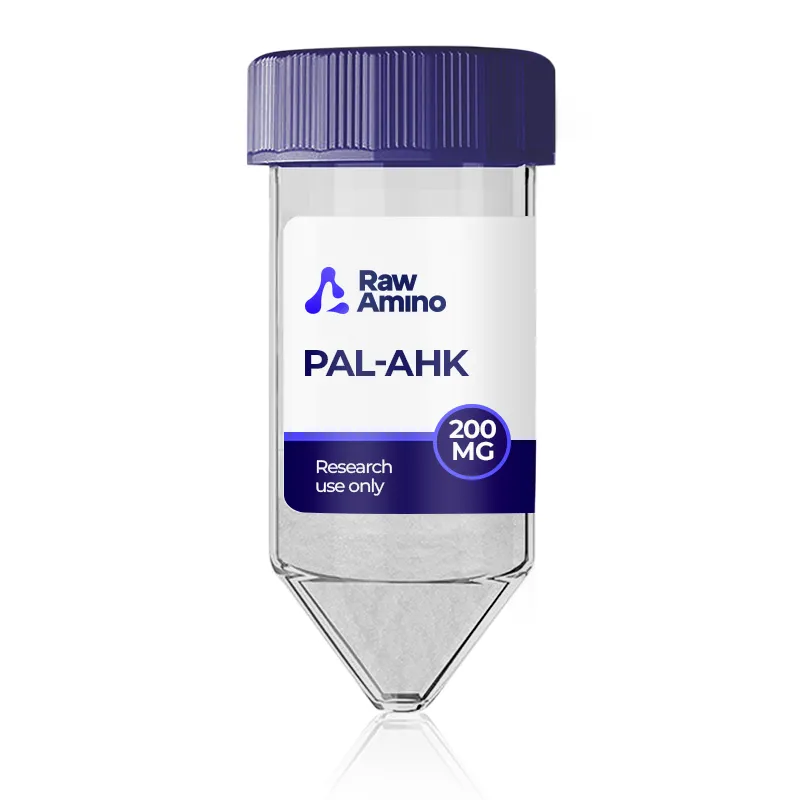
Buy Pal-AHK 200mg online from Raw Amino as a sealed, freeze-dried vial. It’s a palmitoylated tripeptide, supplied in a 200mg vial. We supply it for in-vitro and laboratory research.
What is Pal-AHK?
Pal-AHK is the tripeptide alanine-histidine-lysine with a palmitic acid tail. AHK on its own is the backbone of AHK-Cu, the copper peptide studied in hair research; the palmitoyl version drops the copper and adds a fatty acid instead.
That fatty chain makes the molecule more oil-friendly, so it blends into creams and passes the outer skin layer more easily than the bare tripeptide.
Ordering Pal-AHK 200mg online at Raw Amino
Raw Amino keeps Pal-AHK 200mg in stock at $184. When you order, you get:
- Free shipping on every order, to any country we deliver to
- New customers save 10% with code firstrawamino$$
- 15% off when you check out with crypto
- Currently in stock; every vial ships sealed and labelled
What Pal-AHK does in the lab
The AHK sequence is thought to act on dermal fibroblasts and hair follicle cells, nudging them toward growth and matrix production.
Palmitoylation is a standard trick in cosmetic peptide chemistry. The lipid tail doesn’t change the signal the peptide sends, it changes where the peptide can go, helping it reach living cells beneath the surface.
Pal-AHK 200mg at a glance
- Compound: Pal-AHK
- Also known as: palmitoyl tripeptide-3, palmitoyl AHK
- Amount: 200mg per vial
- Form: freeze-dried (lyophilized) powder in a sealed glass vial
- SKU: RA-PAL-AHK-200MG
- Stock: in stock
- Use: laboratory research only
Published studies on Pal-AHK
Work on the parent sequence is better documented than work on the palmitoyl form. Pyo and colleagues reported in 2007 (Archives of Pharmacal Research) that AHK-Cu made cultured human hair follicle cells grow and stretched follicles in organ culture.
For Pal-AHK itself, most data are supplier studies on skin cells looking at collagen output. Treat it as an early-stage cosmetic peptide.
For abstracts and full papers, use this PubMed search run by the National Library of Medicine.
Pal-AHK vs related compounds
In short, Pal-AHK is the AHK tripeptide with a palmitic acid tail and no copper. Here’s how its closest relatives differ:
- GHK-Cu is the copper-binding tripeptide studied for collagen and skin repair
- Lipopeptide carries the elastin motif VGVAPG with a palmitic acid tail
- AHK-Cu is the alanine version of the copper tripeptide, studied mostly in hair follicle models
- Matrixyl is the collagen-fragment signal peptide sold as Matrixyl
- Syn-Coll copies thrombospondin-1 to free TGF-beta and push collagen output
- Palmitoyl Tetrapeptide-7 is the other half of Matrixyl 3000, studied for lowering IL-6 in skin
Collagen and repair peptides make up most of our skin range. The copper peptides carry a metal ion, the palmitoyl ones a fatty acid, and each copies a different piece of the skin’s own matrix. See them side by side on our skin and cosmetic peptides page.
The Pal-AHK 200mg label
Look for the Raw Amino logo, the name of the compound, the Research use only band and the strength, 200mg. Those four things tell you you’ve got the right vial.
Freeze-dried peptide often looks like very little powder, sometimes just a thin white layer. That’s normal. The amount is set by weight, not by how full the vial looks.
If your protocol requires in-house confirmation, set a little material aside from the first vial for your own analysis before the study starts.
Pal-AHK 200mg mixing chart
Work out concentration by dividing what’s in the vial by the water you add. For example:
- 200mg vial plus 5mL of water: 40mg per mL
- 200mg vial plus 10mL of water: 20mg per mL
Use sterile bacteriostatic water and add it slowly against the glass, not straight onto the powder. Swirl or roll the vial until nothing is left at the bottom. Give it a minute or two if it’s slow; never shake it.
Label the vial with the concentration and today’s date before it goes in the fridge.
Storing Pal-AHK 200mg
Put unopened Pal-AHK 200mg in the freezer at -20°C and keep it in its box. The dry powder handles a few days at room temperature in the post without trouble.
Mixed solution goes in the fridge between 2 and 8°C and should be used within roughly a month. Keep the other vials sealed and frozen until you need them.
Related skin and cosmetic peptides
- SNAP-8 200mg: an octapeptide
- Palmitoyl Tetrapeptide-7 200mg: a cosmetic tetrapeptide
- Melanotan 1 10mg: an alpha-MSH analog
- BPC-157 TB-500 GHK-Cu Blend 70mg: BPC-157, TB-500 and GHK-Cu in one vial
- Pal-GHK 200mg: a palmitoyl tripeptide
Compare more options in the skin and cosmetic peptides range or go back to the Raw Amino shop.
Pal-AHK 200mg questions and answers
How much is in the Pal-AHK 200mg vial?
200mg of freeze-dried Pal-AHK. The amount is printed on the label.
What do I mix Pal-AHK 200mg with?
Sterile bacteriostatic water. The mixing chart above shows the concentration you get from each volume.
How should I store Pal-AHK 200mg?
Freeze sealed vials at -20°C. Once mixed, keep it at 2 to 8°C in the fridge and use it within about four weeks.
Can Pal-AHK be used in people or animals?
No. Raw Amino sells it for laboratory research only. It’s not approved for human or veterinary use.
Is Pal-AHK 200mg in stock?
Yes. It’s in stock now.
Order Pal-AHK 200mg from Raw Amino
Ready to order? Pal-AHK 200mg costs $184 with free worldwide shipping. First-time buyers save 10% with code firstrawamino$$.
Building a bigger order? Our skin and cosmetic peptides are all on one page.
Raw Amino sells this product for laboratory research only. It isn’t for human or veterinary use, and these statements haven’t been evaluated by the FDA.
Reviews
There are no reviews yet.